Personal Political Statement


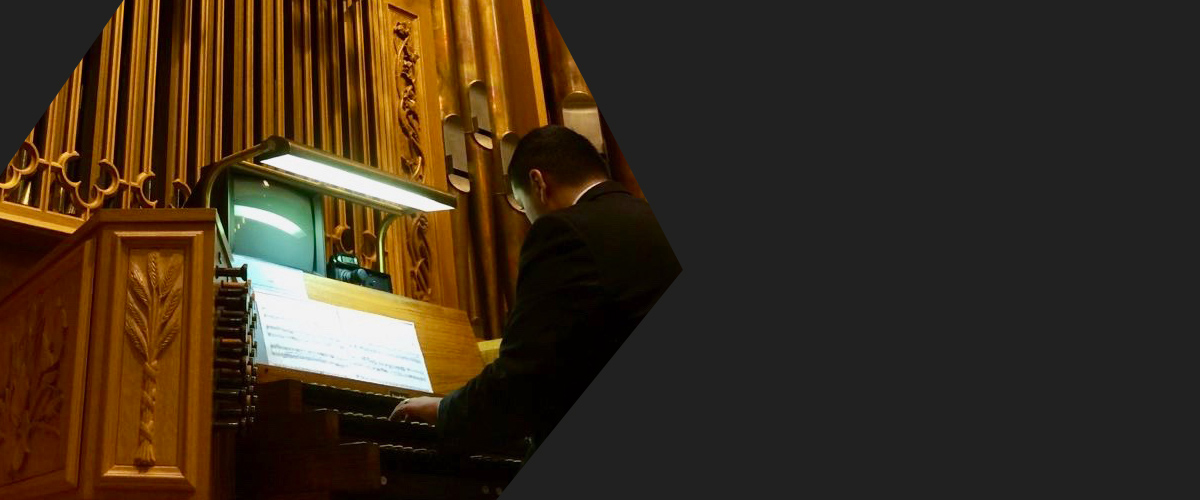
Photo by Peter Lazaravich

Bookmark and Share

"...if we permit government to manufacture its own authority out of thin air, and to create self-proclaimed powers not delegated to it by the people, then the creature exceeds the creator and becomes Master."
Ezra Taft Benson
[Read More...]


Johann Sebastian Bach: A Faithful Servant


Bookmark and Share
I published the following article in the monthly Newsletter of the First Presbyterian Church of Annandale:

Since I became organist of the Church in August, I have played at least four pieces during the worship service that have been authored Johann Sebastian Bach. You will probably continue to hear his music as long as I am the organist, so I want to introduce you to J. S. Bach for the benefit of those who may not be familiar with his life and works.

Johann Sebastian Bach was born in 1685 in the city of Eisenach in central Germany. He was blessed to be born in a family of musicians by profession, who prided in their art. The young Johann Sebastian lost both of his parents early in his life, and subsequently moved with his older brother Johann Christoph, who was himself an accomplished organist and a former pupil of the famed organist Johannes Pachelbel. His brother gave the young Johann Sebastian his first organ lessons.

Bach demonstrated early on that he was no ordinary child. He excelled in school and quickly became a young organ prodigy. He got his first organist position at the St. Boniface church in Arnstadt. From then on, his reputation as a great organist continued to grow and he moved to most prestigious positions, including the Court of the Imperial city of Weimar, in which he was the court composer for many years.
His reputation was such that an observer once made the comment that Bach “could play with his feet faster than other people could play with their hands.”

Besides Bach’s talent at the keyboard and as a composer, he was a very religious man. When Bach died, his library contained all the works of Martin Luther with notes and comments, and an exhaustively marked up bible. In almost every Bach manuscript sheet music, one can unequivocally find one of two inscriptions: SDG (Soli Deo Gloria – trans. To God Alone the Glory) or JJ (Jesu Juva – trans. Jesus Help me.)
Johann Sebastian Bach died in 1750 in Leipzig, and left a legacy of faith and excellence in music that remains unsurpassed. As you hear his music, I hope you remember the man’s devotion and his genius, which was laid on the altar as an offering to our God, and may we all say, as he did: To God Alone the Glory!

Felipe Dominguez, Organist
First Presbyterian Church of Annandale


[Read More...]


Cantantibus Organis (Petrucci Library)


Bookmark and Share
This afternoon I was looking for some music that eventually led me to this collection published originally by Friedrich Pustet and re-issued by Noetzel Verlag in 1979. The collection is not one that organists are widely familiar with and I thought I should promote its virtues a little.
The collection contains 19 volumes of renaissance/early baroque organ music, which can be downloaded individually from the Petrucci Library website. Each volume contains repertoire proper to a certain religious order, court, geographic area or in some cases liturgical calendar. The typeset is friendly and its registration indications helpful.

Download all the volumes at the Petrucci Library page


[Read More...]


Links


[Read More...]


OTHER INTERESTS

 
Return to top of page Copyright Felipe Dominguez © 2011 | Platinum Theme Converted into Blogger Template by HackTutors